
- Growth
- Overall matches the lowest of the 4 conditions.
- Genes
- G, Y, and H are good; W and X are bad.
- Clones
- Inherit the original plant’s genes.
- Watering
- A pump by fresh water can supply up to 4 sprinklers.
- Fertilizer
- Raises soil condition in a planter to 100%.
What affects growth and yield
Look at a plant to open its condition panel. Pay particular attention to Overall, which determines its growth rate. The higher the value, the faster the plant grows and the more it yields.
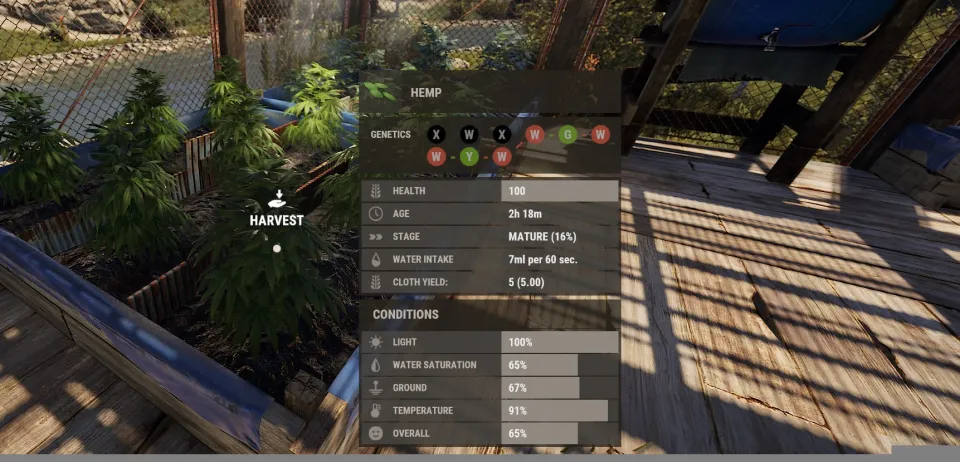
Growth depends on 4 conditions. Overall matches the lowest one, so start by fixing the weakest link. If temperature is holding a plant back, more light won’t solve the problem.
- Light. Plants grow faster in sunlight and under ceiling lights.
- Water saturation. Check it in the plant panel while setting up irrigation.
- Soil condition. Fertilizer raises it to 100%.
- Temperature. It also lowers Overall if it’s below the other conditions.
Each plant species has its own tolerance for growing conditions, shown on the seed panel. Potatoes grow almost anywhere, but restore less health. We’d start by checking the plant panel: it shows which condition is holding growth back.
Plant genetics in Rust: six slots and what each letter means
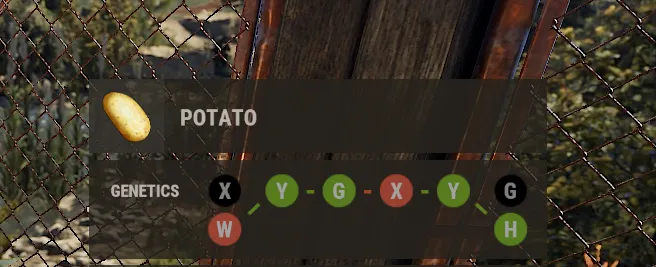
Each plant has 6 gene slots. Good genes are green, and bad ones are red. Wild plant seeds have a random set of genes, which you can only see after planting them.
| Gene | Type | Effect |
|---|---|---|
| G | Good | Speeds up plant growth |
| Y | Good | Increases yield and the number of clones |
| H | Good | Makes the plant more resistant to poor temperature conditions |
| W | Bad | Increases water consumption |
| X | Bad | Empty gene |
What’s the difference between GGGYYY and GGYYYY?
Players usually aim for GGGYYY or GGYYYY. GGGYYY grows faster and produces 3 clones when cloned. GGYYYY produces 4. These sets are listed in the Facepunch wiki.
It depends on what you’re after. For faster growth, we’d pick GGGYYY; for cloning, GGYYYY. H helps when temperature is an issue, while W increases the plant’s water needs.
How to clone and crossbreed plants
A clone inherits the original plant’s genes. Once you’ve found the set you want, cloning preserves it for future plantings. Crossbreeding serves a different purpose: it lets you replace individual genes using nearby plants.
When a plant reaches the crossbreeding stage, it compares its genes with those of nearby plants one slot at a time. If enough nearby plants have the same gene in a slot, that gene replaces the plant’s own. For example, W can turn into G if 2 nearby plants have G in that slot.
- Plant a seed and check its genesPlant a seed to reveal its genes, then choose a plant with a set you want to improve.
- Choose nearby plantsYou need plants of the same species with the desired gene in the same slot. More good genes are needed to replace a bad one.
- Plant them togetherCrossbreeding only works in a planter and only between plants of the same species.
- Wait for crossbreedingWhen crossbreeding begins, check the panel to see which slots changed.
- Clone the resultClone the result to preserve its genes for future plantings.
Bad genes carry more weight than good ones. You need more good genes in the same slot to replace a bad one. Check the slots on every plant you’re crossbreeding.
Compare the gene in the slot you want to change, not the total number of Gs and Ys in a set. A gene can only be replaced if nearby plants have the matching gene in the same slot.
Which planters to use and how to plant faster
Planters are used to grow plants and crossbreed them. Along with the Large Planter Box, there’s a triangular planter for triangle foundations and planters from the Frontier Pack. Choose the shape that fits your farm.
- The Large Planter Box holds 9 seeds, while the Small Planter Box holds 3.
- The Triangle Planter Box holds 4 seeds. Its maximum soil saturation is 3,000, the same as the Small Planter Box.
- The Frontier Pack includes a planter cart that holds 2 seeds and a bathtub planter that holds 3. Since March 2025, the Railway Planter has been a skin for the regular planter.
You can harvest, clone, or remove every plant in a planter with a single action. To plant quickly, hold sprint and all the seeds in your hand will go into the planter at once.
Plants grow faster under ceiling lights and in sunlight. After planting, check the light level in the plant panel along with the other conditions. Good lighting helps only when water, soil, or temperature isn’t the limiting factor.
How to connect a Sprinkler in Rust
You can place a Sprinkler on a wall, floor, or ceiling to water planters within range. Connect water outlets with a Hose Tool, much like you’d connect electrical outlets with a wire. Use a Fluid Splitter to split the water into 3 outputs.
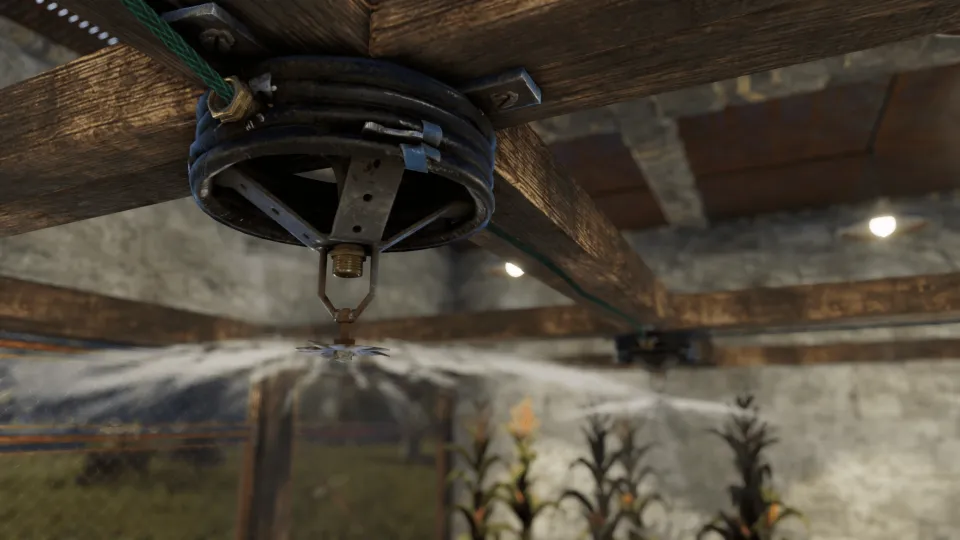
Water flows horizontally and downward. To move it uphill, you need a Fluid Switch with a pump. It has a water input and output, plus 3 electrical inputs for the pump and the on/off switches.
Pumps, barrels, and salt water
At a river or freshwater lake, power a Water Pump and connect up to 4 sprinklers to it. For salt water, use 2 pumps connected through a powered Water Purifier. You can connect up to 6 sprinklers to one water barrel.
- Water sourcePower a Water Pump by a river or freshwater lake. For salt water, use 2 pumps connected through a powered Water Purifier.
- Hoses and splittingConnect outlets with a Hose Tool. Use a Fluid Splitter to branch the water into 3 outputs.
- Pumping water uphillTo pump water above its source, install a Fluid Switch with a pump.
- SprinklersPlace sprinklers above the planters and check water saturation in the plant panels.
Water barrels and Water Catchers have inputs and outputs. You can link Water Catchers in a chain, and they’ll drain into a barrel automatically. See Farming Basics for pump and barrel setups.
A December 2023 fix addressed sprinklers losing up to 40% of their water when watering 4 or 9 planters. Don’t account for that old loss in your watering setup.
How the Composter works in Rust
Put compostable items into the Composter. By default, the composter processes its contents every 15 minutes and yields Fertilizer once enough material has decomposed. Some materials break down better than others and produce more fertilizer. Since the Breach and Clear update (03.09.2026), the composter displays how long processing will take. Adding fertilizer to a planter box brings soil quality up to 100%.
Horse dung produces a lot of fertilizer. Since June 2024, you can also put bone fragments in the Composter. Use fertilizer when soil is holding growth back. You’ll need to manage light, water, and temperature separately.
For where to find manure and how to raise cows and sheep, see our guide to animal husbandry in Rust.
Where to find seeds with good genes
Look for planters by the Water Well monument. They periodically grow random plants on their own, and those plants are more likely to have good genes. It’s a quick way to find plants to clone and bring a useful gene set back to your farm.
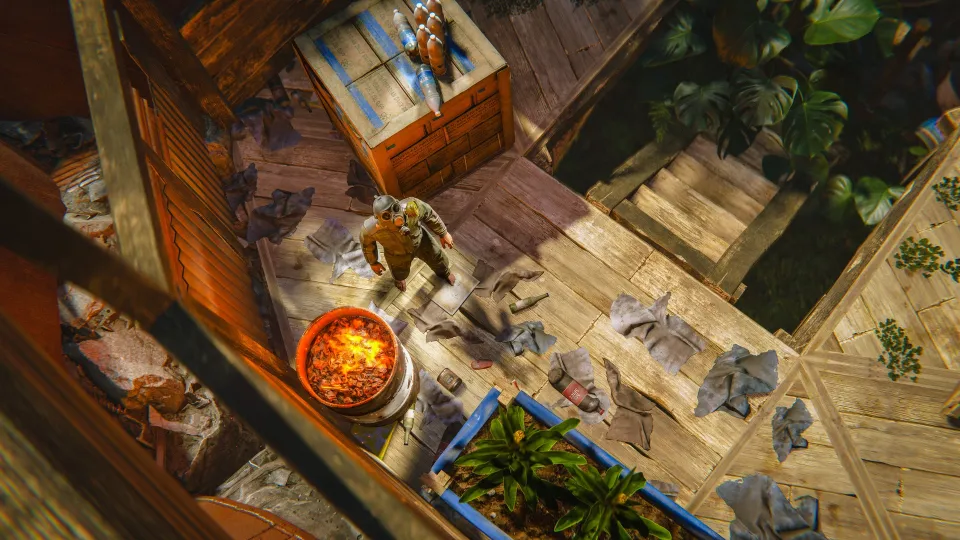
There’s a stash with tea and food near the well. For your farm, check the planters themselves: inspect the genes and pick a plant you want to propagate. Cloning preserves its gene set.
Frequently asked questions
Which genes are best in Rust?
Players usually aim for GGGYYY or GGYYYY. The first set grows faster and produces 3 clones; the second produces 4. G, Y, and H are good genes, while W and X are bad.
How do you crossbreed plants in Rust?
Plant several plants of the same species in a planter, then choose nearby plants with the genes you want in the right slots. During crossbreeding, each plant compares every slot with its neighbors. Bad genes carry more weight, so replacing one takes more good matches.
How many sprinklers can you connect to a pump?
You can connect up to 4 sprinklers to a powered Water Pump by a river or freshwater lake. For salt water, use 2 pumps connected through a powered Water Purifier. You can connect up to 6 sprinklers to one water barrel.
How do you get fertilizer in Rust?
Put compostable items in the Composter, which processes its contents every 15 minutes by default. Horse dung yields plenty of fertilizer, and bone fragments work too. Fertilizer raises soil condition in a planter to 100%.